
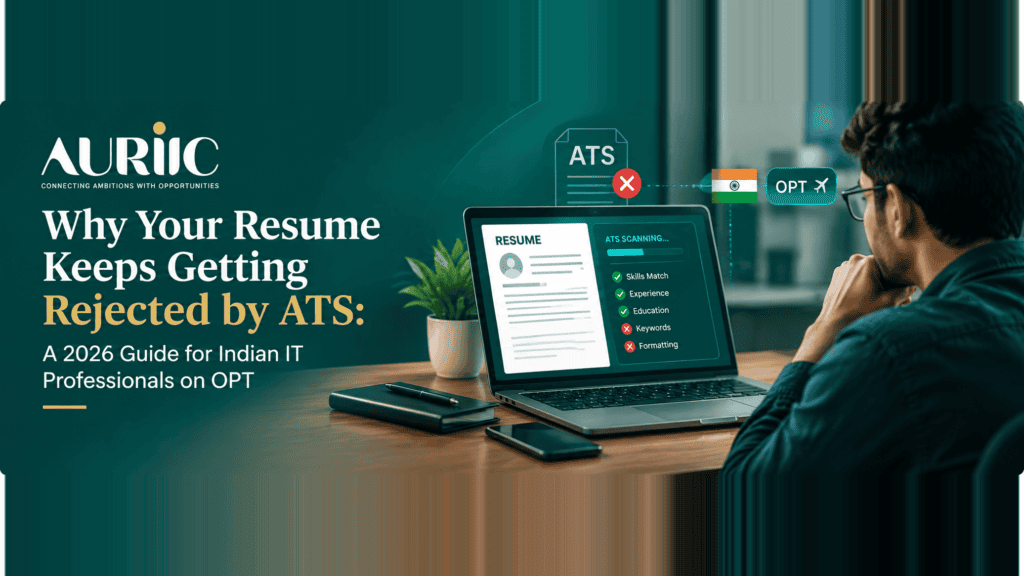
If you’ve sent out 150, 200, even 300 applications and heard back from almost none of them, it’s tempting to conclude the market is impossible or that you’re simply not qualified enough. In most cases, neither is true. What’s actually happening is quieter and much more fixable: your resume isn’t making it past the software before a human ever sees it.
It’s rarely a qualifications problem
Most candidates on OPT applying for IT roles are qualified for the jobs they’re applying to. The real issue is usually structural: the Applicant Tracking System can’t parse the resume correctly, so it never reaches a recruiter at all, regardless of how strong the candidate is.
That distinction matters because it changes what you should fix. You don’t need more projects on your resume. You need your existing experience to actually get read.
How an ATS actually reads your resume
An ATS doesn’t read a resume the way a person does. It parses the document into a structured format, pulling out sections like work experience, education, and skills, then matches that data against the job description’s requirements. If the parsing step fails, even a strong candidate gets filtered out before anyone opens the file.
The most common self-inflicted mistakes
Tables and multi-column layouts look clean but often break parsing entirely, scrambling the order of your information or dropping sections.
Headers and footers containing key details are frequently invisible to ATS software. Contact information belongs in the main body of the document.
Creative fonts and graphics, like icons or skill bars, can either fail to parse or clutter the extracted text in ways that confuse keyword matching.
Missing keywords from the actual job description is a big one. ATS systems typically rank resumes on keyword overlap with the posting. If the job description says “CI/CD pipeline” and your resume says “deployment automation,” you may not get matched, even if you mean the same thing.
One generic resume for every application will consistently underperform against a resume tailored to each posting’s specific language.
Image-based resumes, or PDFs exported from design tools, sometimes can’t be parsed for text at all.
What tailoring actually means
Tailoring doesn’t mean rewriting your resume from scratch every time. It means pulling five to eight keywords directly from the job description’s requirements section, making sure those terms (or close variants) show up naturally in your experience bullets, and reordering or lightly rewording those bullets to lead with the most relevant experience for that role. Keep the formatting simple throughout: standard section headers, no tables, no columns, no graphics.
A simple structural checklist
- Single-column layout, standard fonts like Arial, Calibri, or Times New Roman
- Standard section headers: “Work Experience,” “Education,” “Skills,” not creative alternatives
- Contact information in the main body, not the header or footer
- Job description keywords reflected naturally in your bullets
- Saved as a standard .docx or text-based PDF, not an image export
The pattern we see repeatedly
Many candidates respond to low response rates by applying to more jobs, faster. In practice, a stronger, more targeted resume usually changes outcomes faster than sending more applications into the same broken system. It’s not about working harder on the search. It’s about making sure the resume that’s already strong actually gets seen.
Save this before your next application round, and share it with someone on OPT who’s been applying without hearing back.