
How to Optimize Your LinkedIn Profile as an International Student Job Seeker in the US

How to Optimize Your LinkedIn Profile as an International Student Job Seeker in the US

Here’s something most job seekers underestimate: by the time a recruiter opens your resume, they’ve often already looked at your LinkedIn. If your profile is thin, inconsistent, or reads like an unfinished draft, it can undercut a strong resume before the conversation even starts.

For international students and OPT candidates specifically, LinkedIn carries extra weight. It’s often the first place a recruiter looks to understand your experience, your network, and how seriously you’re approaching your career in the US.

Why LinkedIn matters more than people think

Recruiters use LinkedIn to cross-check the resume, gauge how active a candidate is in their field, and get a sense of professional presence before ever picking up the phone. A resume shows what you’ve done. LinkedIn shows how you show up.

The profile elements that matter most for OPT and STEM OPT candidates

Your headline is prime real estate, and most people waste it by just listing a job title. A stronger version signals your target role and your value clearly, without oversharing sensitive visa details in a public headline. Something like “Software Engineer | Java, Spring Boot, AWS | Actively seeking full-time opportunities” says far more than a bare title.

Your About section is where you tell a short, clear professional story: what you do, what you’re looking for, and what makes you effective. Skip generic lines like “passionate and hardworking individual.” Recruiters skim this section fast, so make the first two lines count.

The Featured section is underused. Projects, GitHub links, certifications, or writing samples placed here give recruiters something concrete to click into instead of relying on your summary alone.

Keep your skills list current and relevant to the roles you’re targeting. An outdated or overly broad list dilutes your profile’s focus in search results.

The invisible profile problem

A well-written profile that nobody sees doesn’t help you. LinkedIn’s visibility in search and recruiter results is shaped by activity and engagement, not just how complete your profile is. Plenty of strong candidates have excellent profiles that are functionally invisible because there’s no consistent activity behind them.

A realistic weekly habit, not a content hustle

You don’t need to post daily to benefit from this. A simple, sustainable pattern: comment thoughtfully on three to five posts a week in your field, since that shows up in your network’s feed and builds visibility. Send two or three personalized connection requests a week to people at companies or in roles you’re targeting. Update your profile whenever you finish a new project, certification, or role, and don’t let it go stale for months.

This kind of consistency compounds. A single viral post does less for your job search than months of steady, visible engagement.

The bigger picture

A strong LinkedIn presence isn’t a replacement for a solid job search strategy. It’s one part of a broader system that includes your resume, your interview preparation, and how you network. Candidates who treat LinkedIn as an afterthought often wonder why strong resumes aren’t converting into conversations. Strengthening your profile is one of the areas where a small, focused effort tends to produce outsized results, and it’s part of what Auriic works through with candidates as part of a complete career strategy.

Follow Auriic for practical career guidance, and tell us in the comments: what’s the one thing missing from your LinkedIn profile right now?
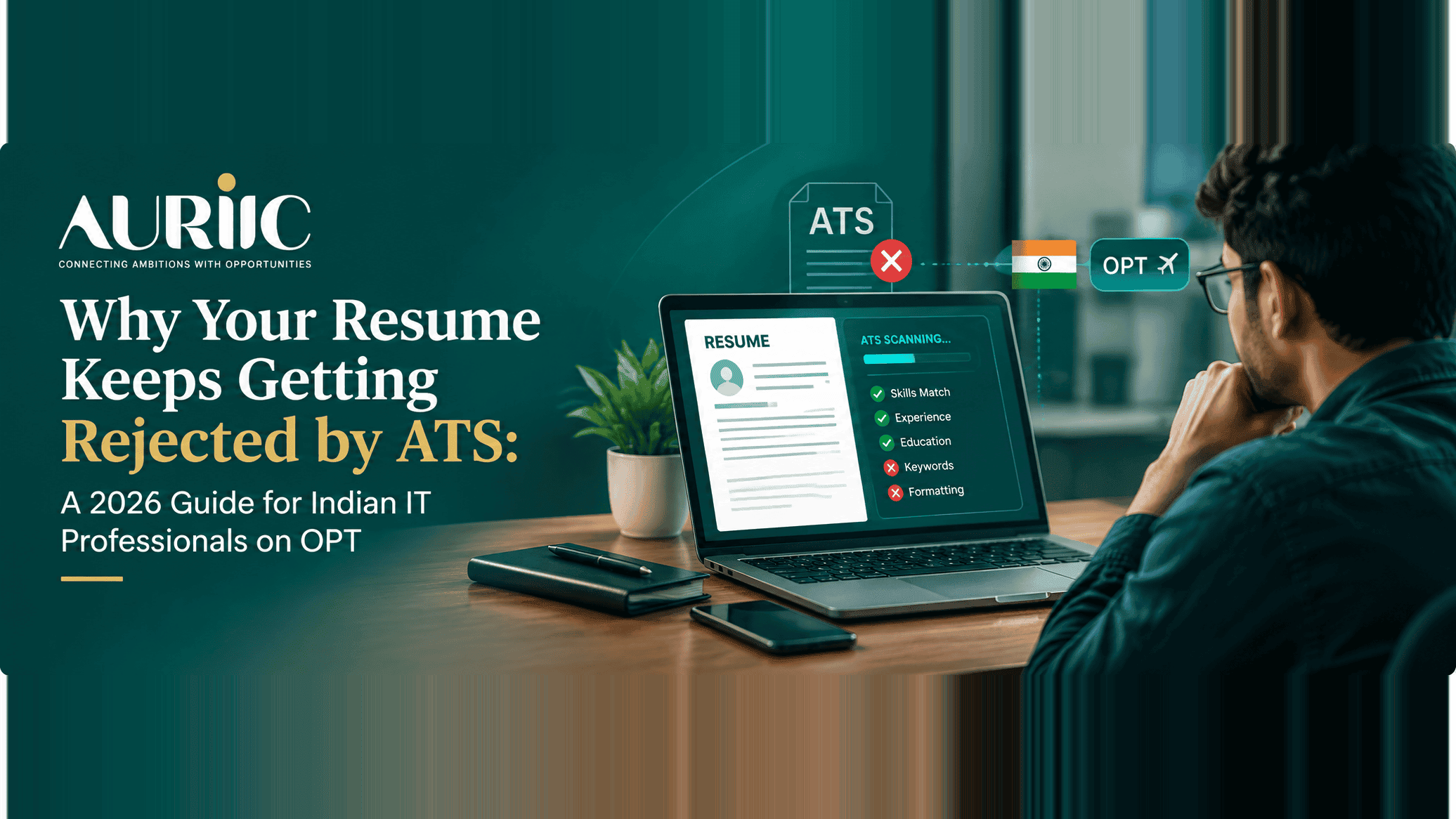
Why Your Resume Keeps Getting Rejected by ATS: A 2026 Guide for Indian IT Professionals on OPT

Why Your Resume Keeps Getting Rejected by ATS: A 2026 Guide for Indian IT Professionals on OPT

If you’ve sent out 150, 200, even 300 applications and heard back from almost none of them, it’s tempting to conclude the market is impossible or that you’re simply not qualified enough. In most cases, neither is true. What’s actually happening is quieter and much more fixable: your resume isn’t making it past the software before a human ever sees it.

It’s rarely a qualifications problem

Most candidates on OPT applying for IT roles are qualified for the jobs they’re applying to. The real issue is usually structural: the Applicant Tracking System can’t parse the resume correctly, so it never reaches a recruiter at all, regardless of how strong the candidate is.

That distinction matters because it changes what you should fix. You don’t need more projects on your resume. You need your existing experience to actually get read.

How an ATS actually reads your resume

An ATS doesn’t read a resume the way a person does. It parses the document into a structured format, pulling out sections like work experience, education, and skills, then matches that data against the job description’s requirements. If the parsing step fails, even a strong candidate gets filtered out before anyone opens the file.

The most common self-inflicted mistakes

Tables and multi-column layouts look clean but often break parsing entirely, scrambling the order of your information or dropping sections.

Headers and footers containing key details are frequently invisible to ATS software. Contact information belongs in the main body of the document.

Creative fonts and graphics, like icons or skill bars, can either fail to parse or clutter the extracted text in ways that confuse keyword matching.

Missing keywords from the actual job description is a big one. ATS systems typically rank resumes on keyword overlap with the posting. If the job description says “CI/CD pipeline” and your resume says “deployment automation,” you may not get matched, even if you mean the same thing.

One generic resume for every application will consistently underperform against a resume tailored to each posting’s specific language.

Image-based resumes, or PDFs exported from design tools, sometimes can’t be parsed for text at all.

What tailoring actually means

Tailoring doesn’t mean rewriting your resume from scratch every time. It means pulling five to eight keywords directly from the job description’s requirements section, making sure those terms (or close variants) show up naturally in your experience bullets, and reordering or lightly rewording those bullets to lead with the most relevant experience for that role. Keep the formatting simple throughout: standard section headers, no tables, no columns, no graphics.

A simple structural checklist

  • Single-column layout, standard fonts like Arial, Calibri, or Times New Roman
  • Standard section headers: “Work Experience,” “Education,” “Skills,” not creative alternatives
  • Contact information in the main body, not the header or footer
  • Job description keywords reflected naturally in your bullets
  • Saved as a standard .docx or text-based PDF, not an image export

The pattern we see repeatedly

Many candidates respond to low response rates by applying to more jobs, faster. In practice, a stronger, more targeted resume usually changes outcomes faster than sending more applications into the same broken system. It’s not about working harder on the search. It’s about making sure the resume that’s already strong actually gets seen.

Save this before your next application round, and share it with someone on OPT who’s been applying without hearing back.

How to Answer “Do You Need Sponsorship?” Without Losing Your Confidence in the Room

How to Answer “Do You Need Sponsorship?” Without Losing Your Confidence in the Room

For candidates on OPT or planning ahead to H-1B, this question can land right when the conversation has been going well. It’s easy to feel your stomach drop, over-explain, or apologize for something that isn’t a flaw at all. Here’s a calmer way to think about it.

Why this question feels so loaded

Unlike most interview questions, this one isn’t really about your skills. It’s about logistics. But because it’s tied to identity, timeline, and sometimes anxiety about being seen as extra work for an employer, candidates often respond with more nervousness than the question actually warrants. That nervousness, more than the honest answer itself, is usually what creates an awkward moment.

What the question is actually asking

Most of the time, an interviewer or recruiter asking this question needs to understand your current work authorization status and whether sponsorship, now or later, will be required to keep you employed long term. That’s it. It’s a planning question, not a judgment.

A clear, confident way to answer

A strong answer is short, factual, and forward-looking:

“I’m currently authorized to work in the US through OPT [or STEM OPT], and I’d need H-1B sponsorship to continue working here long term. I wanted to be upfront about that early in our conversation.”

That states the facts plainly, shows you understand your own timeline, and signals transparency, which recruiters consistently value more than candidates expect.

What to avoid

Over-explaining or apologizing is the biggest one. Needing sponsorship isn’t a weakness in your candidacy; it’s a standard part of many companies’ hiring processes for international talent. Treating it like a confession undermines an otherwise strong interview.

Guessing at company policy is another. If you don’t know whether the company sponsors H-1B visas, it’s fine to ask directly: “Is your team able to sponsor H-1B for this role?” That’s a normal, expected question, not an uncomfortable one.

And waiting too long to bring it up rarely helps. If sponsorship will be needed and it hasn’t come up naturally, raising it yourself before the offer stage tends to build more trust than avoiding the topic.

If the answer is “we don’t sponsor”

This will happen sometimes, and it’s useful information, not a rejection of you personally. A short, professional response, such as “I understand, thank you for letting me know early,” keeps the relationship intact. Recruiters move between companies, and a professional exit from a conversation like this is sometimes remembered longer than people expect.

The confidence shift that actually helps

Candidates who prepare a short, matter-of-fact answer in advance tend to deliver it far more naturally than those hearing the question for the first time in the room. It’s worth practicing out loud once or twice, not to memorize a script, but to remove the hesitation that comes from being caught off guard.

This is a small but recurring moment in almost every international candidate’s job search, and how it’s handled often shapes the rest of the interview’s tone. Preparing for it, alongside the rest of your interview strategy, is exactly the kind of unglamorous work that tends to make the biggest difference. It’s part of what Auriic works through with candidates ahead of interviews, not just resume and LinkedIn prep.

Save this before your next interview, and share it with someone who’s dreading this exact question.

Why “Just Apply Online” Isn’t Working: A Networking Guide for International IT Job Seekers

Why “Just Apply Online” Isn’t Working: A Networking Guide for International IT Job Seekers

If your job search has mostly meant submitting applications and waiting, you’ve probably noticed the response rate doesn’t match the effort. This is one of the most common patterns among Indian IT professionals and recent graduates in the US: solid technical skills, a reasonable resume, and still, silence.

The missing piece is usually networking. Not the vague, uncomfortable version of “working a room,” but the specific, low-pressure kind that actually moves a job search forward.

Why networking matters more than most candidates assume

A large share of roles get filled through referrals and warm introductions before, or instead of, ever being posted publicly. That doesn’t mean applying online is pointless. It means it shouldn’t be your only strategy. When someone inside a company can vouch for you, your resume skips the anonymous pile and lands in front of a person instead of a system.

Why this feels harder for international candidates

Many international students and OPT candidates arrive with a strong academic network in India and a thin professional one in the US. Reaching out to strangers can also feel intrusive early on, which often leads candidates to avoid it altogether and default back to cold applications.

The good news: networking that works doesn’t have to feel transactional. It works best when it’s built around genuine curiosity and small, specific asks.

A practical approach that doesn’t feel awkward

Start with alumni, not strangers. Search LinkedIn for graduates from your university who work at your target companies or in your target roles. Shared background makes outreach feel far less cold.

Ask for insight, not a job. A message asking “Would you be open to a 15-minute call about your experience in [role]?” gets a much better response than one that implicitly asks for a referral. People are generally happy to share advice. They’re more hesitant to vouch for someone they just met.

Follow up with something specific. After a conversation, a short thank-you note referencing something the person actually said shows you were listening, and keeps you memorable weeks later when a role opens up.

Go into events with a plan. Whether it’s a meetup, a conference, or a university career fair, walk in with two or three specific people or companies in mind, instead of trying to talk to everyone in the room.

Give before you ask. Share an interesting article, congratulate someone on a new role, or pass along a useful resource. Small, genuine gestures make a future ask feel natural instead of sudden.

What this looks like over a few months

Networking rarely produces instant results, which is exactly why most people give up on it too early. A realistic rhythm looks like three to five new connections a week, a handful of short conversations a month, and a slowly growing group of people who actually know who you are and what you’re looking for. That group is what eventually surfaces opportunities that never make it to a job board.

The bigger pattern

Candidates who combine a strong resume with consistent networking tend to see faster, more relevant opportunities than those relying on applications alone. Not because networking replaces the fundamentals, but because it puts those fundamentals in front of the right people. This is one of the areas where a more strategic approach makes a bigger difference than simply doing more of the same thing, and it’s a core part of how Auriic works with candidates on their search strategy.

Why “Just Apply Online” Isn’t Working: A Networking Guide for International IT Job SeekersĀ· Post

Save this if your search has felt like shouting into the void, and share it with someone who’s been applying without much traction.